Made by hand in small batches
Nourish your family,
the way grandma did.
40 தானிய சத்து மாவு. Millets, pulses, whole grains, heritage rice, nuts and seeds — each one roasted separately, cooled properly, then ground and zip-sealed the same day. No preservatives, no added sugar, nothing artificial. Ready in ten minutes.
3.0 / 5 from 1 review
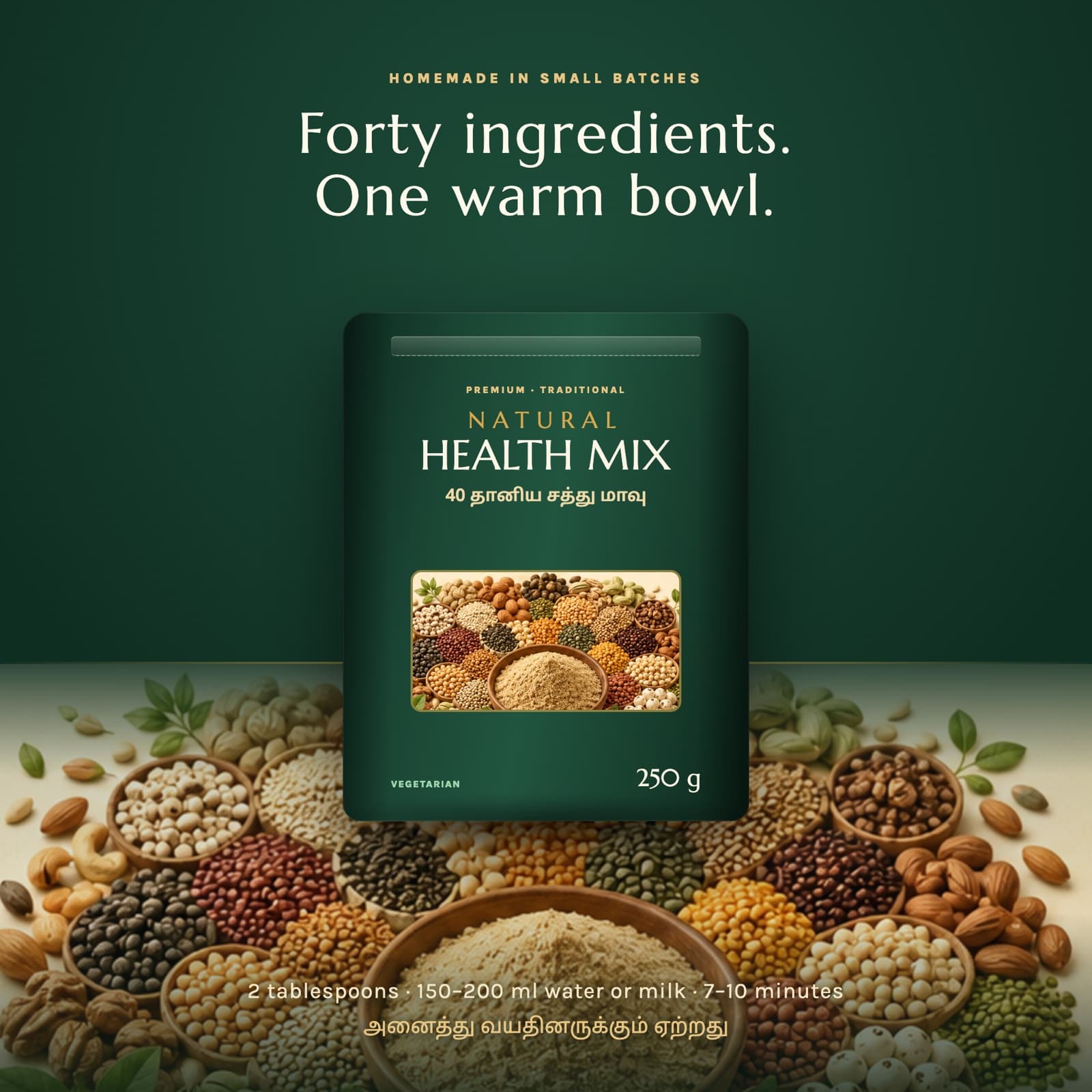
One mix, made properly
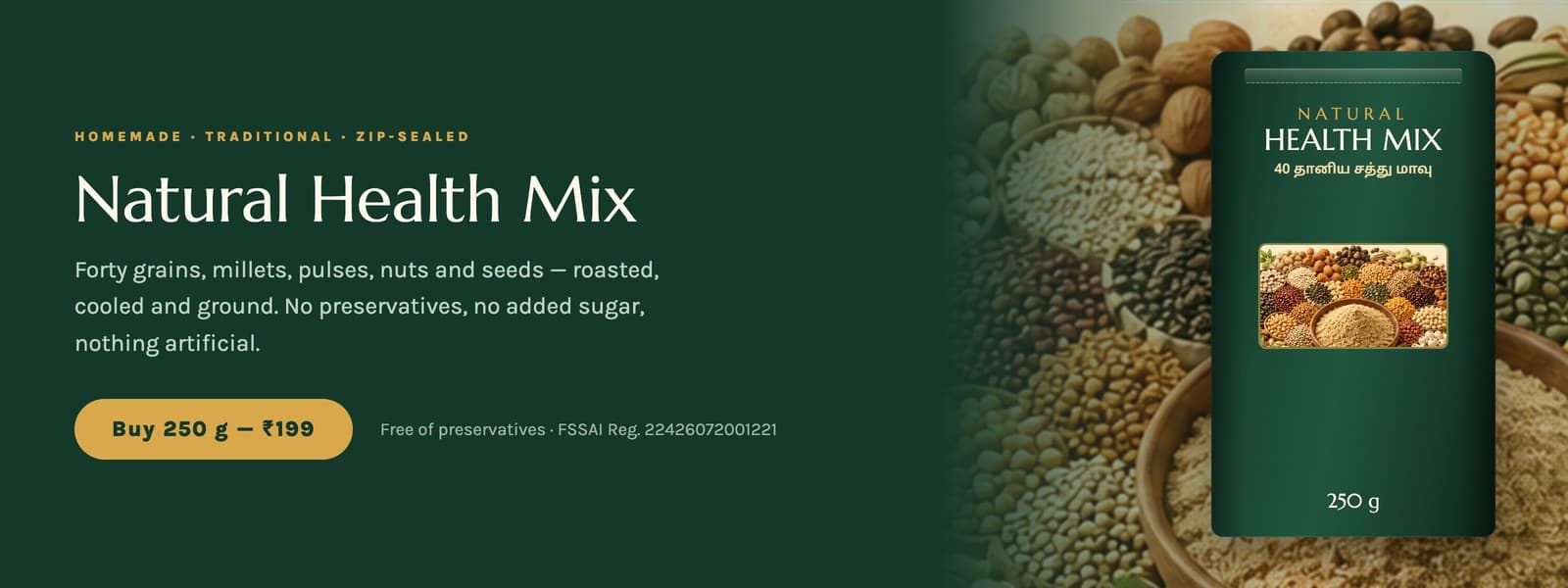
Natural Health Mix
40 தானிய சத்து மாவு · Traditional multi-grain, millet & nut blend
- 7 millets — foxtail to finger
- 10 pulses, grams & beans
- 7 heritage Tamil rice varieties
- 8 nuts & seeds, almond to pistachio
Best value: 1 kg at ₹499 — ₹49.90 / 100g, and it ships free.
Our process
Four steps, none of them shortcuts
Health mix is a simple product made badly by almost everyone. Here is exactly what we do differently, in the order it happens.
- 01
Forty ingredients, bought small
Seven millets, ten pulses, whole grains, four heritage Tamil rice varieties, nuts and seeds. Bought in small quantities and often, rather than a year's stock at once, so nothing sits around losing its oils.
- 02
Roasted one grain at a time
Ragi needs five minutes; chickpea needs fifteen. Roast forty ingredients together and half of it is raw while the rest burns. Each one is roasted on its own, by smell rather than by timer.
- 03
Cooled completely, then ground
Everything is left to cool right down before it is ground. Grinding while warm makes the powder pasty and shortens its life -- it is the step most people skip, and skipping it is why some mixes taste flat.
- 04
Zip-sealed the same day
Ground grain begins to go stale from the moment it is made. Batches are small, zip-sealed the same day, and dispatched within two days, with the packing date on every pouch.
An honest comparison
Why ours costs more than the pack at the corner shop
Read the label of any health mix on a supermarket shelf and you will usually find these six differences. We would rather you checked than took our word.
| What to check | NaturalHealthMix | A typical store pack |
|---|---|---|
| First ingredient on the label | A millet or a pulse | Refined rice flour or maltodextrin |
| Added sugar | None, ever | Often 15–30% of the pack |
| Roasting | Each ingredient separately, by smell | Everything together, by timer |
| Grinding | Cooled completely first, then ground | Ground warm, straight off the roaster |
| Freshness | Packing date printed; 6-month shelf life | Expiry date only, made months ago |
| Ingredient count on the label | All 40 listed, countable | “30 grains!” with 20 at trace levels |
We are describing the common pattern on Indian supermarket shelves, not any one brand. Turn the pack over and read the ingredient list yourself — it is the only claim that cannot be dressed up.
From our customers
What people actually say
Every review below is from a verified order. We publish the mixed ones too.
“Lovely”
we enjoyed a lot, I would recommend it to everyone
“Lovely”
we enjoyed a lot, I would recommend it to everyone
Small batch
since day one
Our story
It started because a shop-bought health mix tasted of nothing.
We grew up on a mix ground at the local mill — you handed over your own grains, waited, and carried home a warm packet that smelled of roasted ragi for days. The version on the supermarket shelf was sweet, pale and smelled of nothing at all.
So we went back to the old method. Buy small. Roast each ingredient on its own. Let it cool right down before grinding. Print the packing date, because that is the number that actually tells you whether it is fresh.
“Every batch is roasted in small quantities, left to cool properly before grinding, and zip-sealed the same day. Made by hand, in the quantities we can actually look after.”
The Journal
Recipes, and how to read a label
Practical, no-nonsense writing about millets, sattu and feeding a family well.
Reading a health mix label: five things worth checking
Most packs on the shelf are mostly rice flour and sugar. Five checks will tell you which is which in about ten seconds.
Read itSeven millets, explained simply — and why a blend beats any one of them
Foxtail, little, kodo, barnyard, proso, pearl and finger millet all get sold as 'millets'. They behave quite differently in a glass.
Read itHow to make health mix kanji that never goes lumpy
Lumps are not your fault and not the powder's fault — they are a temperature problem. Here is the two-minute method that fixes it permanently.
Read it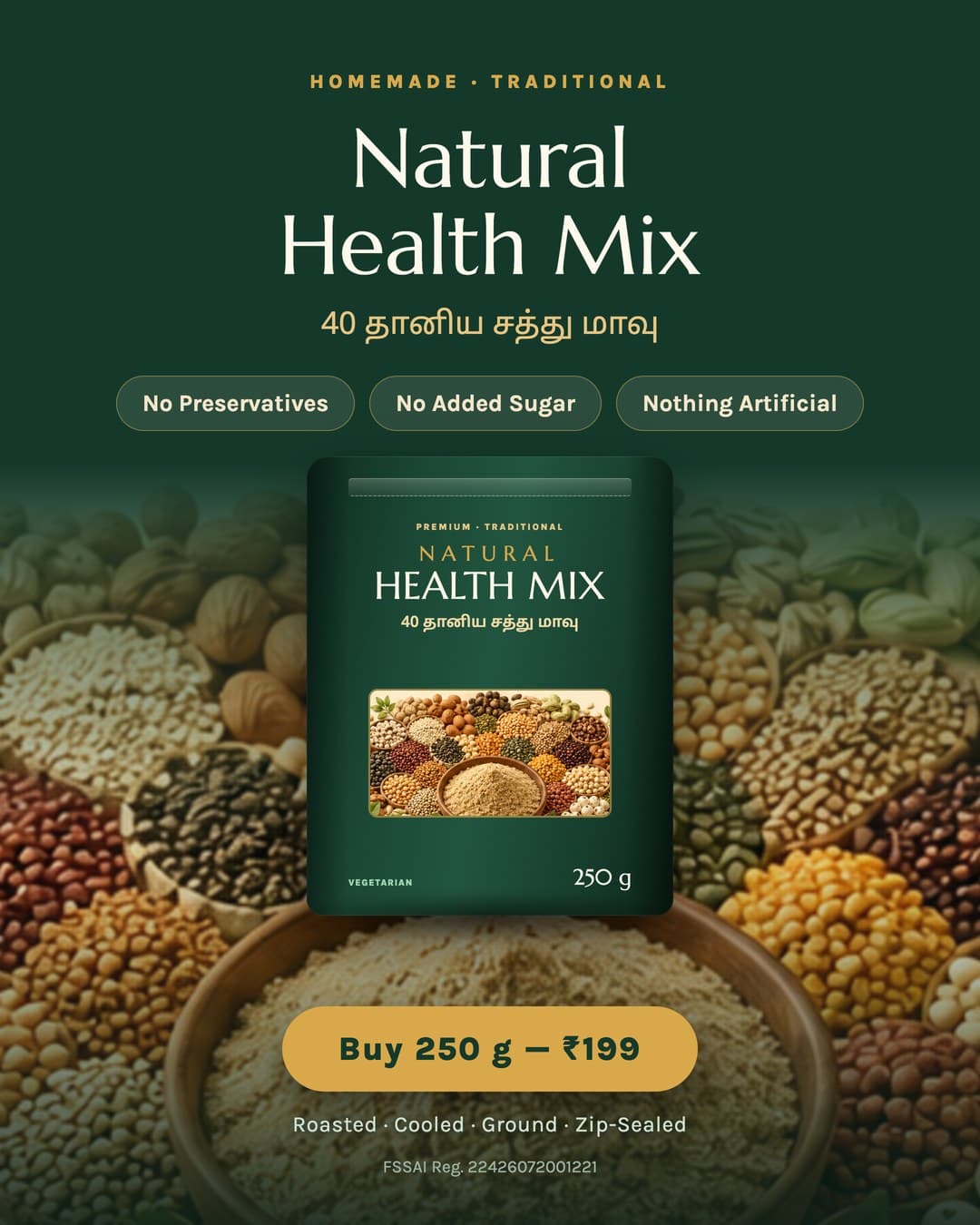
Before you order
Questions people ask us most
How do I make it without lumps?
Make a smooth paste with a little COLD water first (about 3-4 tablespoons), then add the rest of your 150-200 ml of hot water or milk while stirring. Powder tipped straight into hot liquid seals on the outside and traps dry powder inside. Then cook 7-10 minutes on a low to medium flame, stirring continuously.
Is there any added sugar?
None. There is no sugar, jaggery or sweetener of any kind in the pack, and no artificial sweetener either. Add jaggery at home to taste, or have it savoury with a pinch of salt — both are traditional.
What exactly is in it?
Forty ingredients: seven millets (foxtail, little, barnyard, kodo, proso, pearl and finger), ten pulses, grams and beans, seven heritage Tamil rice varieties (mappillai samba, kattu yanam, poongar, kullakar, black kavuni, kar and arupatham kuruvai), grains including barley, samba wheat, sorghum, maize and sago, eight nuts and seeds (almond, cashew, walnut, pistachio, lotus seed, peanut, pumpkin seed and flax seed), plus flattened rice, dry ginger and cardamom. The full list is on the product page and on the back of every pack.
Does it contain nuts or gluten?
Yes to both. It contains almond, cashew, walnut, pistachio and groundnut, and it contains samba wheat and barley, so it is not gluten-free. If anyone in your household has a nut or gluten allergy, this is not a suitable product. Please read the full ingredient list before ordering.
From what age can children have it?
The mix is suitable for all age groups, but it contains nuts, so for a young child please start with a very small quantity and speak to your paediatrician first. This is a food, not an infant formula, and it is not a replacement for breast milk or formula.
How long does a pack last, and how should I store it?
Best before six months from the packing date printed on the pouch, and best flavour within ninety days of packing and thirty days of opening. Keep it in a cool, dry place away from sunlight, zip-sealed after opening, and always use a clean, dry spoon.
How much does one glass cost?
One serving is about 20 g, so a 250 g pack makes roughly 12 servings and a 1 kg pack about 50. At ₹499 for the 1 kg that works out to around ₹10 a glass.
How fast is delivery, and what does it cost?
Orders are packed and dispatched within 1-2 working days. Delivery is typically 3-6 days across India. Shipping is a flat ₹69, and free on orders above ₹499 — which the 1 kg pack qualifies for on its own.
Do you offer cash on delivery?
Yes, with a small ₹30 handling fee, which is what the courier charges us for collecting cash. UPI, cards and netbanking have no fee.
What if I do not like it?
Tell us within 7 days of delivery and we will replace it or refund you, even if the pack is opened. Food is personal and we would rather have your trust than your ₹299.
Still unsure? Ask us anything — we usually reply on WhatsApp within a couple of hours.